Emerging Trends in Bioengineering and Biosciences Research: Opportunities for Scholars in 2026
Emerging Trends in Bioengineering and Biosciences Research: Opportunities for Scholars in 2026
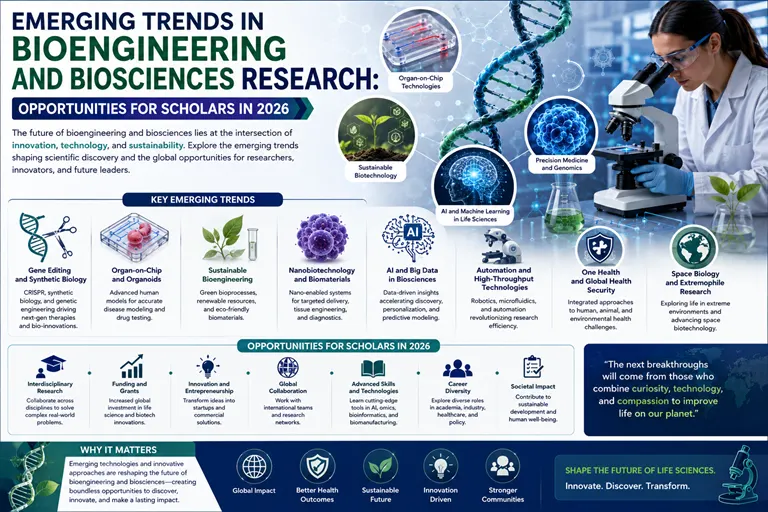
Bioengineering and biosciences are entering one of the most transformative periods in scientific history. The convergence of biology, engineering, computational sciences, artificial intelligence, and medicine is creating new research opportunities that are redefining healthcare, agriculture, environmental sustainability, and industrial biotechnology.
In 2026, researchers are witnessing unprecedented advances in precision medicine, regenerative therapies, synthetic biology, organ-on-chip technologies, artificial intelligence, and sustainable bioprocessing. These developments are not only accelerating scientific discovery but are also opening entirely new avenues for interdisciplinary collaboration and innovation. Recent analyses identify artificial intelligence, regenerative medicine, advanced biomaterials, personalized medicine, and digital health technologies as some of the most influential trends shaping bioengineering in 2026.
For scholars, students, and early-career researchers, understanding these emerging trends is essential for identifying impactful research areas and building successful academic careers.
The Evolution of Modern Bioengineering and Biosciences
Traditionally, biological sciences and engineering evolved as separate disciplines. Today, however, these fields are increasingly interconnected.
Modern biosciences integrate:
- Biology
- Engineering
- Computer science
- Mathematics
- Medicine
- Materials science
- Environmental science
- Artificial intelligence
- Data science
This interdisciplinary approach enables scientists to address complex challenges that cannot be solved through a single field of study. Current developments increasingly emphasize engineering biology, AI-driven research, and sustainable biotechnology solutions.
Why 2026 Is a Turning Point for Biosciences Research
Several factors are accelerating innovation:
- Advances in computing power
- Availability of large biological datasets
- Improved genomic technologies
- Increased global investment in biotechnology
- Stronger academia-industry collaboration
- Growing healthcare demands
- Environmental sustainability challenges
The global bioengineering sector continues to expand rapidly, driven by precision medicine, synthetic biology, sustainable bioprocessing, and AI integration.
For researchers, these changes create enormous opportunities for scientific discovery and scholarly publication.
Trend 1: Artificial Intelligence and Machine Learning in Biosciences
Artificial intelligence is rapidly transforming biological research.
AI applications include:
- Medical image analysis
- Protein structure prediction
- Drug discovery
- Disease diagnostics
- Genomic analysis
- Clinical decision support
- Predictive modelling
- Precision medicine
Machine learning algorithms can process enormous datasets that would be impossible to analyze manually. AI-enhanced diagnostics and predictive analytics are becoming increasingly important in biomedical engineering and healthcare innovation.
Researchers with expertise in both biology and computational sciences are expected to be in particularly high demand.
Research Opportunities
- AI-driven drug discovery
- Computational genomics
- Biomedical image analysis
- Predictive disease modelling
- AI-assisted precision medicine
- Bioinformatics algorithms
Trend 2: Precision Medicine and Personalized Healthcare
Precision medicine seeks to tailor treatments according to an individual's:
- Genetics
- Environment
- Lifestyle
- Disease characteristics
Advances in genomics, multi-omics technologies, and computational biology have significantly accelerated the growth of personalized medicine. Cell therapies and personalized treatments continue to be among the fastest-growing areas in life sciences research.
Research Opportunities
- Genomic medicine
- Pharmacogenomics
- Biomarker discovery
- Personalized therapeutics
- Rare disease research
- Precision diagnostics
Trend 3: Synthetic Biology and Engineering Biology
Synthetic biology combines biology and engineering to design and construct new biological systems.
Applications include:
- Biofuels
- Engineered microorganisms
- Therapeutic cells
- Sustainable manufacturing
- Environmental remediation
- Novel biomaterials
Engineering biology is increasingly recognized as a major contributor to future bioeconomies and climate solutions.
Research Opportunities
- Genetic circuit design
- Synthetic microbial systems
- Sustainable biotechnology
- Cellular engineering
- Bio-based manufacturing
- Climate-oriented biotechnology
Trend 4: Regenerative Medicine and Tissue Engineering
Regenerative medicine remains one of the most exciting areas of bioengineering.
Research focuses on:
- Stem cell therapies
- Tissue regeneration
- Organ engineering
- Biomaterials
- Gene therapies
- Cell-based medicine
Regenerative medicine and bioprinting technologies continue to move from laboratory research toward clinical applications.
Research Opportunities
- Stem cell biology
- Tissue engineering
- Biomaterial development
- Organ regeneration
- Gene editing technologies
- Cell-based therapeutics
Trend 5: Organ-on-Chip and Human-Relevant Experimental Models
Traditional preclinical models often fail to predict human responses accurately.
New technologies include:
- Organ-on-chip systems
- Organoids
- Microphysiological systems
- Three-dimensional tissue cultures
- Human disease models
These technologies are transforming:
- Drug discovery
- Toxicology
- Precision medicine
- Disease modelling
Human-relevant experimental systems are increasingly viewed as the future of preclinical research and translational medicine.
Research Opportunities
- Microfluidics
- Disease modelling
- Drug screening platforms
- Personalized medicine models
- Toxicology research
- Translational biosciences
Trend 6: Advanced Biomaterials and Biomedical Devices
Modern biomaterials are becoming increasingly sophisticated.
Applications include:
- Medical implants
- Drug delivery systems
- Biosensors
- Tissue engineering scaffolds
- Wearable devices
- Regenerative medicine technologies
Advanced biomaterials and next-generation medical technologies are among the fastest-growing sectors in biomedical engineering.
Research Opportunities
- Smart biomaterials
- Nanomaterials
- Biosensors
- Implant technologies
- Controlled drug delivery
- Bioelectronics
Trend 7: Multi-Omics and Systems Biology
The emergence of large-scale biological data has revolutionized scientific research.
Researchers now study:
- Genomics
- Transcriptomics
- Proteomics
- Metabolomics
- Microbiomics
Multi-omics approaches provide comprehensive insights into biological systems and disease mechanisms.
Research Opportunities
- Systems biology
- Computational modelling
- Biomarker identification
- Integrative omics
- Disease mechanisms
- Data-driven medicine
Trend 8: Sustainable Biotechnology and Environmental Biosciences
Sustainability is becoming a major priority in biosciences research.
Areas of interest include:
- Biodegradable materials
- Biofuels
- Circular bioeconomy
- Environmental biotechnology
- Carbon capture technologies
- Green biomanufacturing
Engineering biology is increasingly being applied to climate solutions and sustainable industrial processes.
Research Opportunities
- Environmental biotechnology
- Industrial microbiology
- Bioenergy
- Climate adaptation research
- Sustainable agriculture
- Bioremediation
Trend 9: Gene Editing and Advanced Genetic Technologies
Gene editing technologies continue to transform biological research.
Important developments include:
- CRISPR technologies
- Base editing
- Prime editing
- Gene therapies
- Functional genomics
Recent advances in gene therapy and gene editing are creating entirely new therapeutic possibilities.
Research Opportunities
- Functional genomics
- Therapeutic gene editing
- Genetic engineering
- Precision medicine
- Molecular diagnostics
- Rare disease therapies
Trend 10: Digital Health and Remote Monitoring Technologies
Digital technologies are changing healthcare delivery.
Innovations include:
- Wearable biosensors
- Remote patient monitoring
- Mobile health applications
- Telemedicine technologies
- Digital therapeutics
The integration of engineering and healthcare technologies continues to create significant research opportunities in biomedical innovation.
Why Interdisciplinary Research Will Define the Future
The most impactful scientific questions increasingly require collaboration among:
- Biologists
- Engineers
- Physicians
- Computer scientists
- Mathematicians
- Data scientists
- Environmental scientists
Interdisciplinary research is becoming the defining characteristic of modern bioengineering and biosciences.
Opportunities for Young Researchers and Scholars
Early-career scientists should consider developing expertise in:
- Computational biology
- Artificial intelligence
- Omics technologies
- Translational medicine
- Biomaterials
- Synthetic biology
- Data science
- Precision medicine
Researchers with interdisciplinary skills will likely have significant advantages in both academia and industry.
Publication Opportunities in Emerging Biosciences
The rapid growth of these research areas is creating substantial opportunities for scholarly publication.
High-impact areas include:
- AI in healthcare
- Precision medicine
- Organ-on-chip systems
- Regenerative medicine
- Synthetic biology
- Gene editing
- Sustainable biotechnology
- Multi-omics research
- Biomedical devices
- Translational bioengineering
These areas are expected to remain major drivers of scientific innovation over the coming decade.
The Importance of Scientific Communication
As biosciences become increasingly interdisciplinary, the ability to communicate research effectively becomes even more important.
Researchers should focus on:
- Clear methodology
- Reproducible research
- High-quality figures
- Strong statistical analyses
- Transparent reporting
- Interdisciplinary relevance
Effective scientific communication accelerates innovation and supports global scientific collaboration.
Soft Note for Researchers
The Journal of Development in Bioengineering and Biosciences welcomes original research articles, reviews, and interdisciplinary studies in emerging areas of bioengineering and biosciences, including artificial intelligence, precision medicine, regenerative medicine, organ-on-chip technologies, synthetic biology, environmental biotechnology, and translational research.
Frequently Asked Questions
What are the biggest trends in bioengineering and biosciences research in 2026?
Major trends include artificial intelligence, precision medicine, synthetic biology, regenerative medicine, organ-on-chip technologies, multi-omics, and sustainable biotechnology.
Why is artificial intelligence important in biosciences?
AI enables researchers to analyze complex biological datasets, improve diagnostics, accelerate drug discovery, and develop predictive healthcare solutions.
What is translational bioengineering?
Translational bioengineering focuses on converting scientific discoveries into practical healthcare technologies and clinical applications.
Why is interdisciplinary research becoming essential?
Modern scientific challenges often require expertise from multiple disciplines, including biology, engineering, medicine, and computational sciences.
Which research areas offer the best opportunities for young scholars?
Artificial intelligence, computational biology, regenerative medicine, synthetic biology, precision medicine, and environmental biotechnology offer excellent opportunities.
Are publication opportunities increasing in these fields?
Yes. The rapid growth of interdisciplinary biosciences research is creating significant opportunities for high-quality scholarly publication.
Conclusion
The year 2026 marks an exciting period for bioengineering and biosciences research. Emerging technologies such as artificial intelligence, precision medicine, synthetic biology, regenerative medicine, and advanced human-relevant experimental models are transforming scientific discovery and creating entirely new research opportunities.
As biological sciences continue to converge with engineering and computational technologies, researchers who embrace interdisciplinary approaches will be well positioned to contribute to future innovations that improve healthcare, agriculture, environmental sustainability, and global well-being.
For scholars, students, and early-career scientists, these emerging trends represent not only exciting research directions but also opportunities to make meaningful contributions to some of the most important scientific challenges of our time. The future of bioengineering and biosciences has never been more promising.