
How to Get ISSN and Crossref DOI for a New Bioengineering or Biosciences Journal
How to Get ISSN and Crossref DOI for a New Bioengineering or Biosciences Journal
Launching a new scholarly journal in bioengineering or biosciences is an exciting academic initiative. Around the world, universities, research institutes, scientific societies, and independent publishers are increasingly creating specialized journals to promote emerging research in biotechnology, biomedical engineering, molecular biology, microbiology, genomics, plant sciences, computational biology, and interdisciplinary biosciences.
However, building a journal involves much more than creating a website and inviting authors to submit manuscripts. Two of the most important elements that determine the credibility and discoverability of a scholarly journal are the International Standard Serial Number (ISSN) and the Digital Object Identifier (DOI).
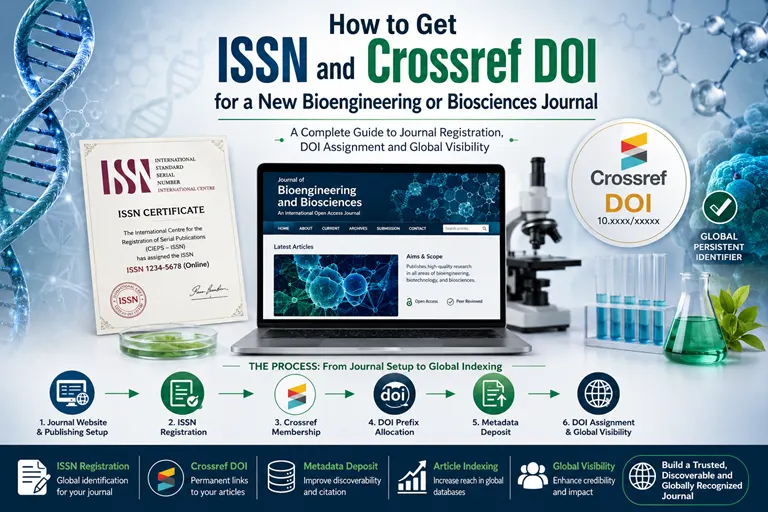
For new journals, there is often confusion regarding when to apply for ISSN, how to obtain Crossref DOI services, whether a website is required before application, and what technical preparations are necessary.
This article provides a practical roadmap for editors, publishers, and journal founders who want to establish a professional bioengineering or biosciences journal with proper ISSN and DOI infrastructure.
Why ISSN and DOI Matter for Academic Journals
The scholarly publishing environment has become increasingly digital and competitive. Authors now expect journals to provide professional publication standards, article identification systems, transparent editorial workflows, and long-term accessibility.
ISSN and DOI play an essential role in this process.
An ISSN identifies the journal as a serial publication, while a DOI uniquely identifies each published article.
Together, they help journals improve:
- Academic credibility
- Article discoverability
- Citation tracking
- Indexing readiness
- Long-term digital preservation
- Metadata quality
- International recognition
- Professional publishing standards
For a new bioengineering or biosciences journal, obtaining ISSN and DOI should be considered an essential part of journal planning rather than an optional step.
What Is an ISSN?
ISSN stands for International Standard Serial Number. It is an internationally recognized eight-digit identifier assigned to serial publications, including scholarly journals.
An ISSN identifies the journal itself, not individual articles.
A journal may receive:
- Print ISSN for printed publications
- Electronic ISSN for online journals
- Both identifiers if the journal is published in both formats
The ISSN helps libraries, databases, indexing services, and readers correctly identify a journal and distinguish it from other publications with similar names.
Why Does a New Biosciences Journal Need an ISSN?
An ISSN demonstrates that a journal has been established as a continuing serial publication with defined publishing intentions.
Many scholarly services and databases expect journals to have an ISSN before considering indexing or inclusion.
For bioengineering and biosciences journals, an ISSN provides several advantages:
- Improves journal credibility
- Supports library cataloguing
- Facilitates indexing applications
- Enhances discoverability
- Helps establish publisher legitimacy
- Supports metadata management
- Creates a professional image for authors and reviewers
Authors often view journals with proper ISSN information as more trustworthy and professionally managed.
What Is a Crossref DOI?
A Digital Object Identifier is a permanent digital identifier assigned to scholarly content.
Unlike ordinary website links, DOI links remain persistent even if a journal changes its website or hosting provider.
For example:
10.xxxx/journal.article.2026.001
Each published article receives its own DOI, making it easier to cite, discover, and track.
Crossref is one of the world's leading DOI registration agencies for scholarly publishing.
A Crossref DOI helps journals:
- Provide persistent article links
- Improve citation management
- Enable metadata sharing
- Support scholarly discovery
- Facilitate indexing and linking
- Improve professional reputation
- Increase article visibility
Why DOI Is Especially Important for Bioengineering and Biosciences Journals
Bioengineering and biosciences research often includes:
- Experimental data
- Complex methodologies
- Supplementary files
- Multi-author collaborations
- Interdisciplinary citations
- International research partnerships
Researchers expect these publications to remain accessible for many years.
DOIs provide long-term article identification and allow future researchers to reliably cite and locate published work.
Without DOI infrastructure, journals may appear less professional to authors and institutions.
Step 1: Establish a Professional Journal Identity
Before applying for ISSN or DOI, the journal should establish its identity.
This includes:
- Journal title
- Publisher name
- Scope and aims
- Editorial board
- Publication frequency
- Publication policies
- Peer review process
- Contact information
For example, a journal such as the Journal of Development in Bioengineering and Biosciences clearly communicates its focus on bioengineering, biosciences, and interdisciplinary scientific research.
A clearly defined identity significantly improves the readiness of the journal for ISSN application and future indexing opportunities.
Step 2: Create a Professional Journal Website
Most new journals underestimate the importance of website readiness.
A professional journal website should include:
- Home page
- About Journal
- Aims and Scope
- Editorial Board
- Instructions for Authors
- Publication Ethics
- Peer Review Policy
- Current Issue
- Archives
- Contact Information
The website should also demonstrate that the journal intends to publish scholarly content on a continuing basis.
Many new journals seek assistance from publishing consultants because website readiness is often one of the most important factors during ISSN preparation.
Need Help Launching Your Journal?
We can help with:
- Journal website development using ScholarJMS
- OJS hosting and migration through OJSCloud
- ISSN consulting and website readiness
- Crossref DOI setup and workflow planning through GetDOI
- Editorial workflow implementation
- Journal launch consulting
WhatsApp: +91 82003 85143
Email: inquiry@ojscloud.com
Step 3: Prepare the Journal Before Applying for ISSN
Although requirements vary between national ISSN centres, journals generally need:
- Journal title
- Publisher details
- Publication frequency
- Editorial information
- Journal website
- Publication policies
- Sample content or publication plan
- Contact information
For online journals, a functional and professionally structured website is extremely important.
OJSCloud assists new journals with ISSN consulting and helps ensure that websites are properly prepared before submission.
Common Reasons ISSN Applications Are Delayed
Many new journals experience delays because of:
- Incomplete websites
- Missing editorial information
- Lack of publication policies
- Inconsistent journal information
- Unclear publisher details
- Missing contact information
- Unprofessional website presentation
Proper preparation significantly improves the chances of a smooth ISSN application process.
Step 4: Plan Your DOI Workflow Early
Many journals only think about DOI registration after publishing articles.
This often creates unnecessary problems.
DOI planning should begin before the first issue is published.
Editors should determine:
- DOI structure
- Metadata standards
- Article numbering system
- URL strategy
- Workflow responsibilities
- Deposit procedures
A well-planned DOI workflow saves considerable time and reduces publishing errors.
Step 5: Understand How Crossref Membership Works
Many new journal publishers are unfamiliar with Crossref requirements.
A journal typically needs:
- Professional website
- Publishing policies
- Article metadata
- DOI deposit procedures
- Long-term publishing intentions
Because DOI setup can seem technically complicated, many journals seek guidance from DOI specialists.
GetDOI helps journals with:
- Crossref guidance
- DOI sponsorship support
- DOI workflow planning
- Metadata preparation
- DOI implementation assistance
Why Metadata Quality Matters
High-quality metadata improves:
- Search engine visibility
- Citation linking
- Article discoverability
- Indexing readiness
- Scholarly communication
For biosciences journals, metadata quality is particularly important because articles often involve highly specialized scientific terminology and interdisciplinary research fields.
Step 6: Publish Your First Articles Professionally
Before pursuing indexing opportunities, journals should demonstrate publishing consistency.
The first issue should include:
- Proper article structure
- Complete metadata
- Professional PDF formatting
- DOI assignment
- Publication dates
- Author affiliations
- References
- Ethical statements
A professionally published first issue creates confidence among authors and reviewers.
Step 7: Prepare for Future Indexing
Although ISSN and DOI do not automatically guarantee indexing, they significantly improve journal readiness.
Many indexing services expect journals to have:
- ISSN
- DOI
- Publication ethics
- Editorial transparency
- Regular publication schedule
- Article metadata
- Professional website structure
Building these foundations early makes future growth easier.
Why Modern Journal Management Platforms Matter
Launching a new journal today requires more than a simple website.
Editors increasingly need:
- Manuscript submission systems
- Editorial workflow tracking
- Reviewer management
- Automated notifications
- Article publishing tools
- Metadata management
- Archive management
ScholarJMS provides an integrated platform designed specifically for scholarly journals and can help new journals establish professional publishing workflows from the beginning.
How OJSCloud Supports New Journal Launches
OJSCloud provides support for:
- OJS hosting
- Journal website setup
- Journal launch consulting
- ISSN consulting
- OJS migration
- Technical support
- Publishing advisory services
This can be especially valuable for institutions launching their first bioengineering or biosciences journal.
How GetDOI Supports DOI Readiness
GetDOI helps journals with:
- Crossref DOI guidance
- DOI sponsorship support
- Metadata preparation
- DOI workflow planning
- Publishing consultation
A structured DOI workflow significantly improves long-term journal management.
Planning to Launch a New Biosciences Journal?
We can help with:
- Journal website setup using ScholarJMS
- ISSN consulting and journal readiness
- OJS hosting and support
- Crossref DOI guidance through GetDOI
- Editorial workflow implementation
- Journal launch consulting
WhatsApp: +91 82003 85143
Email: inquiry@ojscloud.com
Frequently Asked Questions
Can I apply for ISSN without a journal website?
Requirements vary by country, but most online journals benefit from having a professional website before applying.
Do I need DOI before publishing my first issue?
No, but planning DOI implementation before publication is strongly recommended.
Does ISSN automatically provide indexing?
No. ISSN identifies the journal but does not guarantee indexing.
Does DOI increase journal credibility?
Yes. DOI assignment improves article identification, discoverability, and professional appearance.
Can a new journal obtain DOI support without becoming a technical expert?
Yes. Services such as GetDOI can help journals understand DOI workflows and implementation requirements.
Should new journals use a manuscript management system?
Yes. Modern systems such as ScholarJMS improve editorial efficiency and provide a better experience for authors and reviewers.
Conclusion
Creating a successful bioengineering or biosciences journal requires strong academic foundations and professional publishing infrastructure. ISSN and Crossref DOI are among the most important building blocks of a credible scholarly journal.
Editors and publishers should approach ISSN and DOI planning strategically by establishing a professional website, implementing clear publication policies, creating structured workflows, and preparing high-quality metadata.
For new journals, obtaining expert guidance can significantly simplify the process and reduce costly mistakes.
Whether you are planning a new journal launch, preparing for ISSN application, implementing DOI workflows, or building a modern journal website, early planning can help your journal establish long-term credibility and visibility in the global scholarly publishing ecosystem.
For assistance with journal website setup, ISSN consulting, DOI guidance, OJS support, and journal launch services, contact:
WhatsApp: +91 82003 85143
Email: inquiry@ojscloud.com