How to Migrate an OJS Biosciences Journal to a Modern Journal Management Platform
How to Migrate an OJS Biosciences Journal to a Modern Journal Management Platform
The publishing needs of biosciences journals are changing rapidly. Journals in bioengineering, biotechnology, biomedical sciences, molecular biology, microbiology, plant sciences, animal sciences, and related life science disciplines now need more than a basic online submission portal. They need a complete digital publishing ecosystem that supports manuscript submission, editorial screening, peer review, production tracking, article publishing, indexing readiness, DOI planning, author communication, and long-term journal visibility.
The Journal of Development in Bioengineering and Biosciences represents this new generation of scholarly publishing. As an open access, peer-reviewed journal focused on bioengineering and biosciences research, JDBB is positioned for interdisciplinary scholarship across biological, biomedical, and engineering-linked research areas. The journal website also shows that it is powered by ScholarJMS and published quarterly, which reflects the growing shift toward structured digital journal management systems for emerging academic journals.
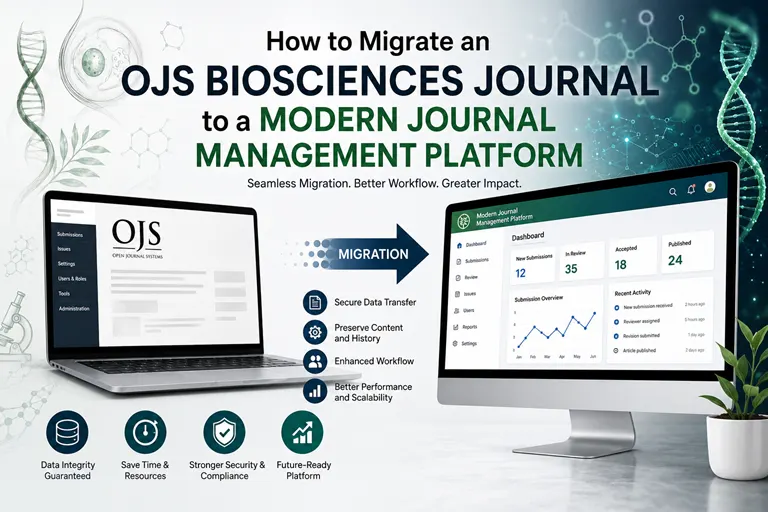
Many established biosciences journals, however, still run on older OJS installations. Open Journal Systems has helped many journals enter online publishing, but over time some journals begin to face limitations related to design flexibility, technical maintenance, submission usability, editorial workflow clarity, plugin management, security updates, DOI workflow, and indexing readiness. For biosciences journals that want to grow professionally, migration from an older OJS setup to a modern journal management platform can become an important strategic decision.
This article explains how a biosciences journal can migrate from OJS to a modern journal management platform without losing academic credibility, article history, editorial continuity, or author trust. It also outlines how platforms and services such as ScholarJMS, OJSCloud, GetDOI, and Scholar9 can support journals during website migration, ISSN readiness, DOI workflow planning, peer review improvement, and long-term journal development.
Why Biosciences Journals Outgrow Older OJS Setups
OJS is widely used in academic publishing, especially among universities, societies, independent publishers, and open access journals. It provides basic journal hosting, submission management, editorial workflow, and publishing tools. For many journals, it is a practical starting point.
However, biosciences journals often develop more complex needs as they grow. A journal that begins with a small number of submissions may later need stronger editorial dashboards, reviewer tracking, article-level metadata control, DOI support, special issue handling, archive management, responsive journal pages, SEO-friendly article pages, and better author communication.
In biosciences, publishing workflows can also be more demanding because manuscripts often include figures, datasets, supplementary files, ethics statements, conflict of interest declarations, graphical abstracts, review comments, revised files, and detailed methodological information. If the journal platform is slow, outdated, poorly maintained, or difficult for authors and editors to use, the journal’s growth may suffer.
Some common reasons biosciences journals consider OJS migration include:
Slow or outdated journal website design
Difficulty managing submissions and reviewer communication
Plugin errors or technical issues after OJS updates
Poor mobile experience for authors and readers
Weak SEO structure for articles and journal pages
Lack of clear DOI workflow planning
Limited support for journal branding
Difficulty preparing for indexing and metadata quality
Confusing editorial workflow for editors and reviewers
Need for better publishing support and long-term maintenance
Migration is not just a technical exercise. It is a publishing upgrade.
What a Modern Journal Management Platform Should Provide
A modern journal management platform should support the complete life cycle of scholarly publishing. It should not only host journal pages, but also improve editorial efficiency, author experience, peer review transparency, metadata quality, and publishing credibility.
For a biosciences journal, the platform should ideally include:
A professional journal website
Online manuscript submission
Editorial screening workflow
Reviewer assignment and review tracking
Author revision management
Article publishing and archive structure
Volume and issue management
Author guidelines and policy pages
SEO-friendly article pages
DOI metadata preparation
Indexing readiness support
Email notifications and communication workflow
Secure admin, editor, reviewer, and author access
Mobile-responsive design
Long-term technical support
ScholarJMS is designed for journals that want a structured journal website, manuscript submission system, editorial workflow, and article publishing framework in one platform. For journals currently using OJS, a migration to ScholarJMS can help create a more modern, branded, and workflow-friendly journal experience.
OJSCloud can support journals that want to continue with OJS hosting, improve their OJS setup, migrate from old OJS versions, or shift from OJS to a more modern publishing platform. This makes OJSCloud useful for both journals that want to upgrade OJS and journals that want to migrate away from it.
When Should a Biosciences Journal Consider Migration?
A journal should consider migration when the current platform begins to restrict growth, reduce editorial efficiency, or create technical risk. Migration may be especially important when the journal is preparing for indexing, applying for ISSN, improving DOI workflows, attracting international submissions, or expanding into special issues.
For example, a biosciences journal publishing research in biotechnology, bioengineering, drug development, preclinical models, organ-on-chip technologies, molecular biology, or biomedical innovation must present itself professionally. Authors often judge a journal’s credibility by its website, editorial policies, submission process, DOI structure, archive quality, and article visibility.
A journal should seriously consider migration if:
Authors complain about submission difficulty
Editors find it hard to track manuscripts
Reviewers miss emails or deadlines due to unclear workflow
The journal website looks outdated
Articles are not properly structured for search engines
Metadata is incomplete or inconsistent
DOI assignment is manual or poorly planned
The journal needs ISSN consulting or website readiness improvement
The OJS installation is outdated or unsupported
Technical support is unreliable
The journal wants to improve branding and credibility
Migration should be planned before the situation becomes urgent. A well-planned migration protects journal continuity and improves the journal’s future publishing capacity.
Step 1: Audit the Existing OJS Journal
Before migration begins, the journal owner, editor, or publisher should conduct a full audit of the current OJS website. This audit should identify what must be preserved, what should be improved, and what can be removed.
The audit should cover:
Journal title and abbreviation
ISSN or ISSN application status
Editorial board details
Aims and scope
Author guidelines
Peer review policy
Publication ethics
Copyright and licensing policy
Archive structure
Published volumes and issues
Article metadata
PDF files and supplementary files
Author and reviewer records
Current submission status
DOI records, if already assigned
Indexing links and citations
Website pages and menus
Email templates and communication flow
For biosciences journals, the audit should also check whether article metadata includes correct titles, author names, affiliations, abstracts, keywords, references, and subject classification. Biosciences research depends heavily on discoverability, and poor metadata can reduce article visibility in search engines, indexing services, and citation databases.
Step 2: Decide What Type of Migration Is Needed
Not every journal needs the same migration model. Some journals only need technical OJS hosting improvement, while others need a complete platform transformation.
There are generally three migration paths:
OJS to Updated OJS
This is suitable when the journal wants to remain on OJS but needs version upgrades, hosting improvement, plugin cleanup, security support, theme improvement, or workflow repair. OJSCloud can help with OJS hosting, OJS support, old OJS migration, and technical maintenance.
OJS to ScholarJMS
This is suitable when the journal wants a more modern journal website, cleaner manuscript submission process, structured editorial workflow, better branding, and easier publishing management. ScholarJMS is useful for journals that want a complete journal management system rather than a heavily technical OJS environment.
Hybrid Publishing Support
Some journals may want to keep part of their OJS archive while launching a new publishing website or submission system. This approach can be useful for journals with long publication histories, DOI records, or indexing dependencies.
The best migration model depends on the journal’s stage, budget, technical capacity, editorial workload, and long-term publishing goals.
Step 3: Preserve Published Articles and Archives
The most sensitive part of any OJS migration is the archive. Published articles are the journal’s academic record. A biosciences journal must ensure that existing articles remain accessible, properly categorized, and correctly linked.
The migration should preserve:
Volume and issue structure
Article titles
Author names and affiliations
Abstracts
Keywords
PDF files
Supplementary files
Publication dates
DOI links
Article URLs or redirects
Citation information
References where available
If a journal already has DOI links, those DOI records must be handled carefully. Incorrect migration can create broken DOI links, duplicate metadata, or article access errors. That is why DOI planning should be part of the migration process, not an afterthought.
GetDOI can help journals plan Crossref DOI support, DOI workflow guidance, sponsorship routes, metadata preparation, and article-level DOI management.
Need help migrating your OJS biosciences journal?
We can help with:
ScholarJMS journal website setup
OJS to ScholarJMS migration
OJS hosting and technical support through OJSCloud
ISSN consulting and journal readiness support
Crossref DOI support through GetDOI
Editorial workflow setup
Peer review trust support through Scholar9
WhatsApp: +91 82003 85143
Email: inquiry@ojscloud.com
Step 4: Improve Journal Website Structure During Migration
Migration is a good opportunity to improve the journal website, not simply copy old content into a new design. A modern biosciences journal website should be clear, credible, and easy to navigate.
Important pages should include:
Home
About Journal
Aims and Scope
Editorial Board
Instructions for Authors
Submit Manuscript
Peer Review Policy
Publication Ethics
Copyright Policy
Article Processing Charges, if applicable
Current Issue
Archives
Contact Us
For a journal such as the Journal of Development in Bioengineering and Biosciences, the website should clearly communicate its focus on bioengineering, biosciences, life sciences, and interdisciplinary research. It should help authors quickly understand whether their manuscript fits the journal scope.
A strong website structure also helps search engines understand the journal. Each article page, archive page, and policy page should have clear titles, meta descriptions, clean URLs, and structured content.
Step 5: Rebuild the Manuscript Submission Workflow
A major reason to migrate from older OJS setups is to improve manuscript submission and editorial workflow. Authors should be able to submit manuscripts without confusion. Editors should be able to track each manuscript stage clearly.
A modern workflow should include:
Author registration
Manuscript submission form
File upload system
Cover letter and declaration fields
Editorial screening
Reviewer assignment
Review request emails
Reviewer comments
Revision submission
Editorial decision tracking
Acceptance and production stage
Final article publication
In biosciences journals, the submission form should also support important declarations such as ethics approval, informed consent where relevant, conflict of interest, funding, data availability, and supplementary material.
ScholarJMS can support structured manuscript submission and editorial workflow, helping journals reduce manual email handling and improve editorial accountability.
Step 6: Plan ISSN Readiness
ISSN is an important identifier for serial publications. For new and emerging journals, ISSN readiness depends not only on applying for ISSN, but also on having a properly structured journal website, editorial information, publication frequency, scope, publisher details, and published or planned content.
OJSCloud provides ISSN consulting support for journals that need help preparing their website and journal information before applying. This can be especially useful for biosciences journals that are newly launched or moving from an incomplete website to a professional publishing platform.
A journal preparing for ISSN should ensure that the website clearly displays:
Journal title
Publisher name
Publication frequency
Editorial board
Aims and scope
Contact details
Author guidelines
Published content or publication plan
Open access and copyright policies
During migration, journals should make sure ISSN details are preserved or properly updated on the new platform.
Step 7: Plan Crossref DOI Workflow
Crossref DOI planning is essential for journals that want stronger article identification, citation linking, long-term discoverability, and scholarly credibility. DOI setup should not be treated as a last-minute technical task after publication.
A good DOI workflow should define:
Who assigns DOI numbers
When DOI is assigned
How metadata is prepared
How references are handled
How DOI deposits are checked
How corrections are managed
How article URLs are maintained after migration
If a journal migrates from OJS to another system, DOI URLs may need careful planning. Published DOI records should continue to resolve correctly. New DOI records should be created with consistent metadata.
GetDOI can support Crossref DOI setup guidance, DOI sponsorship support, and DOI workflow planning for journals that want professional assistance.
Step 8: Strengthen Peer Review Transparency and Trust
Biosciences research requires strong peer review because articles may influence future laboratory work, clinical research, biotechnology development, environmental research, agricultural biosciences, or biomedical innovation. A modern journal management platform should help editors maintain a reliable and transparent review process.
The journal should define:
Double-blind or single-blind review model
Reviewer selection criteria
Review timeline
Conflict of interest policy
Editorial decision process
Revision policy
Research ethics requirements
Plagiarism screening process
Correction and retraction policy
Scholar9 can support journals that want to build a stronger research trust ecosystem, transparent peer review culture, and better publishing credibility. This is especially valuable for emerging journals that want to demonstrate seriousness to authors, reviewers, institutions, and indexing evaluators.
Step 9: Protect SEO and Article Visibility
One of the biggest risks during migration is loss of search visibility. If old article URLs change without redirects, search engines and readers may lose access to published content.
A migration should include:
URL mapping from old OJS pages to new pages
Redirect planning
Meta title and description improvement
Article schema readiness where possible
Clean archive structure
Keyword-rich article pages
Updated sitemap
Internal linking
Search engine indexing checks
For biosciences journals, SEO is not only about traffic. It is about research discoverability. Authors want their articles to be found by scholars, students, laboratories, institutions, and indexing services.
A modern platform should help each article page become easier to read, search, cite, and share.
Step 10: Train Editors, Reviewers, and Journal Staff
A migration is successful only when the editorial team can use the new system confidently. Training should be part of the migration plan.
Editors should understand:
How to view new submissions
How to assign reviewers
How to send review reminders
How to record decisions
How to request revisions
How to publish accepted articles
How to update issue pages
How to manage article metadata
Reviewers should receive clear instructions on how to accept review invitations, submit comments, and upload review files. Authors should receive simple submission guidance and communication at every stage.
A modern platform should reduce confusion, not create new complexity.
Step 11: Test Before Going Live
Before the migrated journal website goes live, the team should test the system carefully.
Testing should include:
Homepage loading
Menu navigation
Submission form
User registration
Email notifications
Editorial dashboard
Article pages
Archive pages
PDF downloads
DOI links
Contact forms
Mobile responsiveness
Search function
Security settings
For biosciences journals with published archives, article access testing is especially important. Every published paper should open correctly, and each PDF should match the correct article metadata.
Step 12: Announce the Migration Professionally
After migration, the journal should inform authors, reviewers, editors, and readers. A short announcement can help maintain trust and avoid confusion.
The announcement may mention:
The journal has moved to a modern publishing platform
Published articles and archives remain accessible
Submission workflow has been improved
Authors can submit through the new system
Editorial and peer review processes remain active
Contact details for support
This communication is important because many authors may have bookmarked the old OJS website or submission link.
Why ScholarJMS Is a Strong Choice for Biosciences Journals
ScholarJMS is suitable for biosciences journals that want a professional journal website, manuscript submission system, editorial workflow, and article publishing structure in one platform. Instead of depending on multiple disconnected tools, the journal can manage publishing operations through a more organized system.
For emerging journals, ScholarJMS can help create a credible online presence from the beginning. For existing OJS journals, it can help modernize the journal without losing the seriousness of scholarly publishing.
Key benefits include:
Modern journal website structure
Manuscript submission workflow
Editorial and reviewer management
Article publishing and archive setup
Responsive design
Better author experience
Journal branding support
Publishing workflow clarity
How OJSCloud, GetDOI, and Scholar9 Support the Migration Ecosystem
A successful journal migration often needs more than software. It needs publishing knowledge, technical planning, DOI understanding, ISSN readiness, and peer review credibility.
OJSCloud can help with OJS hosting, OJS migration, OJS support, journal launch consulting, ISSN consulting, and publishing advisory support.
GetDOI can help journals with Crossref DOI guidance, DOI sponsorship support, DOI metadata planning, and DOI workflow setup.
Scholar9 can help journals strengthen peer review trust, research transparency, and credibility in scholarly communication.
Together with ScholarJMS, this creates a complete support ecosystem for journals that want to move from a basic online publishing setup to a modern, professional journal management model.
Planning to upgrade your journal platform?
We support journals with:
New journal website setup
OJS to ScholarJMS migration
OJS hosting and support
ISSN consulting
Crossref DOI support
Journal launch guidance
Editorial workflow setup
Peer review trust ecosystem support
WhatsApp: +91 82003 85143
Email: inquiry@ojscloud.com
Common Mistakes to Avoid During OJS Migration
Many journals make migration difficult by treating it as a simple website transfer. In reality, journal migration involves technical, editorial, publishing, and metadata responsibilities.
Avoid these mistakes:
Migrating without backing up the old website
Ignoring DOI URL continuity
Not preserving article metadata
Changing article URLs without redirects
Deleting old issue archives
Failing to test submission workflow
Not training editors and reviewers
Not updating author guidelines
Not checking mobile responsiveness
Not announcing the new platform to authors
For biosciences journals, these mistakes can damage credibility. Authors may hesitate to submit if the journal website looks incomplete or if published articles are hard to access.
Migration Checklist for Biosciences Journals
Before migration:
Audit current OJS website
Backup all files and database
List all published articles
Review DOI and ISSN details
Identify missing metadata
Finalize new platform structure
Prepare policy pages
Confirm editorial workflow needs
During migration:
Transfer journal pages
Transfer article archives
Upload PDFs and supplementary files
Configure submission workflow
Set up user roles
Prepare email templates
Map old URLs to new URLs
Check DOI links
Improve SEO structure
After migration:
Test all pages
Test submission process
Train editorial team
Publish announcement
Submit updated sitemap
Monitor broken links
Review metadata quality
Continue DOI and indexing planning
Frequently Asked Questions
What is OJS migration?
OJS migration is the process of moving a journal from an existing Open Journal Systems setup to an updated OJS installation, improved hosting environment, or a different modern journal management platform such as ScholarJMS.
Why should a biosciences journal migrate from OJS?
A biosciences journal may migrate from OJS to improve website design, submission workflow, peer review management, DOI planning, metadata quality, security, indexing readiness, and author experience.
Will published articles be lost during migration?
Published articles should not be lost if migration is planned properly. Article PDFs, metadata, volume details, issue structure, DOI links, and archive pages should be backed up and transferred carefully.
Can DOI links continue working after migration?
Yes, DOI links can continue working if article URLs and DOI metadata are managed correctly. DOI planning should be included before migration. GetDOI can support journals with Crossref DOI workflow guidance.
Can OJSCloud help with ISSN consulting?
Yes. OJSCloud can help journals with ISSN consulting and journal website readiness support, including required journal information, policy pages, editorial details, and publication structure.
Is ScholarJMS only for new journals?
No. ScholarJMS can be useful for both new journals and existing journals migrating from older systems. It supports journal website setup, manuscript submission, editorial workflow, and article publishing structure.
How long does an OJS journal migration take?
The timeline depends on the size of the archive, number of articles, DOI status, customization needs, and workflow complexity. A small emerging journal may migrate faster than a journal with many years of archived issues.
Should a journal migrate before applying for indexing?
In many cases, yes. A clean, professional, well-structured website can improve indexing readiness. Journals should ensure that aims and scope, editorial board, author guidelines, peer review policy, publication ethics, archives, and article metadata are properly presented.
Conclusion
Migrating an OJS biosciences journal to a modern journal management platform is not simply a technical upgrade. It is a strategic publishing decision that can improve author experience, editorial workflow, peer review quality, DOI readiness, ISSN preparedness, journal branding, article visibility, and long-term credibility.
For journals in bioengineering, biotechnology, biomedical sciences, molecular biology, microbiology, plant sciences, animal sciences, and related biosciences fields, a modern platform can help the journal operate with greater clarity and professionalism. The Journal of Development in Bioengineering and Biosciences reflects the direction in which emerging scholarly journals are moving: structured websites, online submission, peer review workflow, open access publishing, and stronger digital presence.
If your journal is currently running on an old OJS installation or struggling with technical limitations, now may be the right time to plan a professional migration.
For support with ScholarJMS setup, OJS migration, ISSN consulting, Crossref DOI support, journal workflow setup, and publishing guidance, contact:
WhatsApp: +91 82003 85143
Email: inquiry@ojscloud.com