
How to Write a High-Quality Bioengineering or Biosciences Research Paper for Journal Publication
How to Write a High-Quality Bioengineering or Biosciences Research Paper for Journal Publication
Scientific discoveries achieve their greatest impact when they are communicated clearly, accurately, and effectively. In bioengineering and biosciences, research findings often contribute to advances in healthcare, biotechnology, agriculture, environmental science, biomaterials, drug development, and biomedical innovation. However, even excellent research can fail to achieve recognition if it is poorly written or presented.
Every year, thousands of manuscripts are rejected not because the research lacks scientific value, but because the papers suffer from weak organization, unclear writing, inadequate data presentation, or failure to follow journal guidelines.
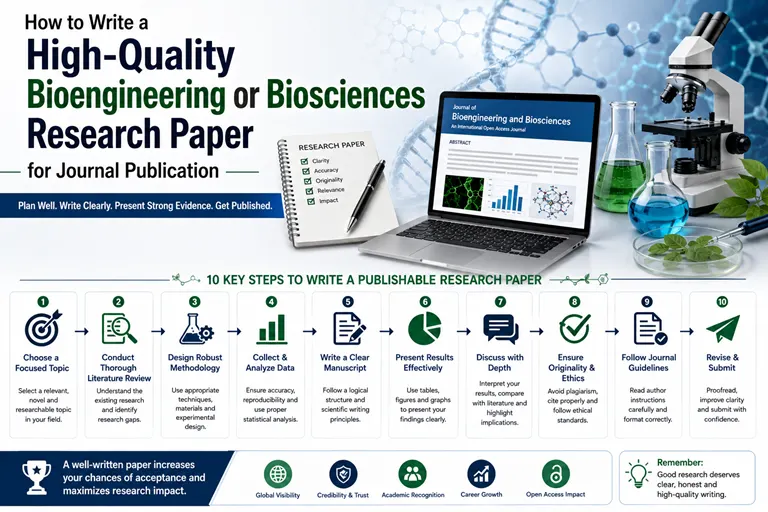
Writing a high-quality research paper is therefore an essential skill for every researcher, postgraduate student, and academic professional.
This guide provides practical advice on preparing a publishable bioengineering or biosciences manuscript that meets the expectations of editors, reviewers, and readers.
Why Scientific Writing Matters
A research paper serves several important purposes:
- Communicates new knowledge
- Allows other researchers to reproduce findings
- Establishes scientific credibility
- Contributes to future research
- Increases academic visibility
- Supports collaboration and funding opportunities
In bioengineering and biosciences, research often involves complex experimental procedures and interdisciplinary approaches. Clear scientific writing helps ensure that these findings are understood and used by the broader scientific community.
Before You Start Writing
Many researchers begin writing only after completing experiments. However, effective scientific writing actually begins during the research process.
Before drafting the manuscript, organize:
- Research objectives
- Hypotheses
- Experimental data
- Statistical analyses
- Figures and tables
- References
- Laboratory notes
- Ethical approvals
- Supplementary materials
A well-organized dataset makes manuscript preparation much easier.
Choose the Right Journal
Before writing the manuscript, researchers should identify an appropriate journal.
Consider:
- Journal scope
- Target audience
- Article types accepted
- Publication policies
- Open-access options
- Review timelines
- Formatting requirements
Submitting to a journal that matches your research area significantly improves the chances of successful publication.
The Journal of Development in Bioengineering and Biosciences welcomes research across bioengineering, biosciences, biotechnology, biomedical sciences, life sciences, and interdisciplinary scientific research, making it suitable for a wide range of innovative studies.
Understand the Structure of a Scientific Paper
Most bioengineering and biosciences journals follow the IMRAD structure:
- Introduction
- Materials and Methods
- Results
- Discussion
Additional sections typically include:
- Title
- Abstract
- Keywords
- Conclusion
- Acknowledgements
- References
- Supplementary Information
Each section has a specific purpose and should be written carefully.
Writing an Effective Title
The title is often the first thing readers and editors see.
A good title should be:
- Specific
- Concise
- Informative
- Scientifically accurate
- Search engine friendly
Avoid:
- Unnecessary abbreviations
- Overly broad statements
- Unsupported claims
- Excessively long titles
Good titles help improve discoverability and attract readers.
Writing a Strong Abstract
The abstract is one of the most important sections of the manuscript because many readers decide whether to read the full paper based on the abstract alone.
A high-quality abstract should include:
- Background
- Objectives
- Methods
- Key findings
- Conclusions
- Significance of the study
Avoid:
- Extensive literature review
- Citations
- Undefined abbreviations
- Excessive technical detail
Most journals recommend abstracts between 200 and 300 words.
Choosing Effective Keywords
Keywords improve article discoverability in databases and search engines.
Select keywords that:
- Reflect the main concepts
- Include important methodologies
- Represent key organisms or technologies
- Match commonly used scientific terminology
Avoid using very general terms that do not adequately describe the research.
Writing the Introduction
The introduction should explain:
- What is already known
- What remains unknown
- Why the study is important
- The objectives of the research
A good introduction answers the question:
Why was this study necessary?
The introduction should gradually guide the reader toward the research question.
Common Mistakes in Introductions
Researchers frequently:
- Include too much background information.
- Write a literature review instead of an introduction.
- Fail to identify the knowledge gap.
- Do not clearly state the study objective.
A focused introduction is more effective than a long and unfocused one.
Writing the Materials and Methods Section
The methods section should provide enough information for another researcher to reproduce the study.
Include:
- Study design
- Experimental procedures
- Sample preparation
- Instruments and equipment
- Statistical methods
- Software used
- Ethical approvals
Bioengineering and biosciences research often requires detailed methodological descriptions because reproducibility is essential for scientific credibility.
Why Reproducibility Matters
Scientific progress depends on reproducible research.
A poorly written methods section can:
- Reduce confidence in findings.
- Delay peer review.
- Lead to manuscript rejection.
- Limit the impact of the research.
Clarity and transparency are therefore essential.
Writing the Results Section
The results section should present findings objectively.
Include:
- Experimental observations
- Statistical analyses
- Figures
- Tables
- Numerical data
Avoid interpreting results extensively in this section.
The primary goal is to present the findings clearly and accurately.
Designing High-Quality Figures and Tables
Figures are particularly important in bioengineering and biosciences.
High-quality figures should:
- Be easy to read
- Have clear labels
- Use appropriate resolution
- Include statistical information where necessary
- Avoid unnecessary complexity
Tables should:
- Present data efficiently
- Avoid duplication of figures
- Include descriptive titles
- Use appropriate units
Poor figure quality is a common reason for reviewer criticism.
Writing the Discussion
The discussion interprets the findings.
It should answer:
- What do the results mean?
- How do they compare with previous studies?
- What are the implications?
- What are the limitations?
- What future research is needed?
The discussion should be balanced and evidence based.
Avoid overstating conclusions or making claims not supported by the data.
Writing a Strong Conclusion
The conclusion should:
- Summarize major findings
- Highlight significance
- Discuss broader implications
- Suggest future directions
A good conclusion is concise and memorable.
Writing the Acknowledgements
This section may include:
- Funding agencies
- Technical assistance
- Institutional support
- Research collaborators
Only individuals who contributed significantly but do not qualify for authorship should be acknowledged.
Preparing References Correctly
Incorrect referencing is a surprisingly common reason for manuscript revisions.
Ensure that:
- Every citation appears in the reference list.
- Every reference is cited in the manuscript.
- Journal formatting requirements are followed.
- DOI information is included when appropriate.
- References are accurate and complete.
Reference management software can significantly reduce errors.
Ethical Considerations in Biosciences Publishing
Modern journals place great emphasis on research integrity.
Researchers should provide information regarding:
- Ethical approvals
- Animal ethics
- Human subject approvals
- Informed consent
- Data availability
- Funding sources
- Conflicts of interest
Failure to disclose ethical information can result in rejection.
Understanding the Peer Review Process
Peer review aims to improve the quality and reliability of scientific publications.
Reviewers may comment on:
- Novelty
- Methodology
- Statistical analysis
- Writing quality
- Interpretation
- Ethical concerns
- References
- Figures and tables
Constructive responses to reviewer comments improve the final manuscript.
Common Reasons Bioengineering and Biosciences Papers Are Rejected
Common reasons include:
- Poor study design
- Weak novelty
- Inadequate methodology
- Incomplete data
- Poor writing
- Ethical concerns
- Weak statistical analysis
- Inappropriate journal selection
- Failure to follow author guidelines
Understanding these issues before submission can significantly improve publication success.
Pre-Submission Checklist
Before submitting your manuscript, verify that you have:
☑ Written a clear title.
☑ Prepared a structured abstract.
☑ Selected effective keywords.
☑ Included all figures and tables.
☑ Described methods adequately.
☑ Completed statistical analyses.
☑ Checked references.
☑ Included ethical declarations.
☑ Prepared supplementary files.
☑ Followed journal guidelines.
Tips for Early-Career Researchers
- Read high-quality papers regularly.
- Learn scientific writing techniques.
- Seek feedback from mentors.
- Revise multiple times.
- Pay attention to clarity and structure.
- Follow journal instructions carefully.
Writing skills improve through practice and experience.
The Importance of Choosing the Right Publication Platform
A journal's editorial standards, peer review quality, and manuscript management system significantly influence the author experience.
Modern journals increasingly use professional manuscript submission systems that provide:
- Submission tracking
- Reviewer management
- Editorial communication
- Revision workflows
- Publication management
A well-managed journal environment benefits both authors and editors.
Soft Note for Authors
Researchers looking for a professional platform to publish interdisciplinary work in bioengineering and biosciences may consider submitting their work to the Journal of Development in Bioengineering and Biosciences, which focuses on advancing high-quality scientific research and promoting interdisciplinary collaboration.
Frequently Asked Questions
How long should a biosciences research paper be?
The length depends on journal requirements and article type. Authors should follow the specific instructions of the target journal.
How many references should a research paper include?
There is no universal number. References should be sufficient to support the study and demonstrate knowledge of previous research.
Can I submit the same manuscript to multiple journals?
No. Simultaneous submission is considered unethical in scholarly publishing.
How important are figures and tables?
They are extremely important because they help communicate complex findings efficiently.
Should I hire professional language editing services?
Researchers who are not confident in their scientific writing may benefit from professional editing before submission.
How long does peer review usually take?
Review timelines vary between journals and depend on reviewer availability and manuscript complexity.
Conclusion
Writing a high-quality bioengineering or biosciences research paper requires more than presenting experimental data. Successful manuscripts combine scientific rigor, clear organization, strong methodology, accurate data presentation, and effective communication.
Researchers who invest time in planning, writing, revising, and following journal guidelines significantly improve their chances of publication success.
As scientific disciplines continue to evolve and become increasingly interdisciplinary, the ability to communicate research effectively remains one of the most valuable skills for every scientist.
A well-written manuscript not only increases the likelihood of publication but also contributes meaningfully to scientific progress and global knowledge sharing.