OJS vs ScholarJMS: Which Platform Is Better for New Biosciences Journals?
OJS vs ScholarJMS: Which Platform Is Better for New Biosciences Journals?
Launching a new biosciences journal requires more than an attractive website. A journal in bioengineering, biotechnology, molecular biology, biomedical sciences, microbiology, plant sciences, animal sciences, or interdisciplinary life sciences needs a reliable publishing system that can manage submissions, peer review, editorial decisions, article publication, metadata, DOI planning, and long-term journal visibility.
For many years, Open Journal Systems, commonly known as OJS, has been one of the most widely used open-source platforms for academic journals. It supports journal publishing, editorial workflow, article metadata, and multi-journal management. The Public Knowledge Project describes OJS as flexible software built for journals across countries, languages, and disciplines, with features such as editorial workflow, branding, metadata, multilingual support, indexing support, and article publishing tools.
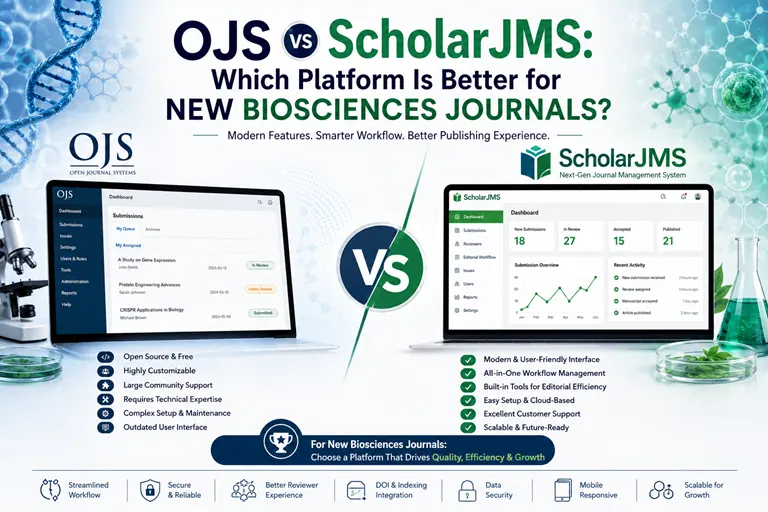
At the same time, new journal founders are increasingly looking for modern alternatives that are easier to set up, cleaner in design, simpler to manage, and better supported for journal launch requirements. ScholarJMS is positioned as a modern journal management system and an alternative to traditional OJS-based setups, with support for journal websites, submission systems, editorial workflow, and Crossref DOI-related publishing requirements.
For a new biosciences journal, the real question is not simply “Which platform is popular?” The better question is: which platform helps the journal launch faster, look credible, manage peer review smoothly, prepare for ISSN and DOI, and build long-term publishing trust?
Understanding OJS
Open Journal Systems is an open-source journal management and publishing platform developed by the Public Knowledge Project. It has been used by many academic institutions, societies, universities, and independent publishers to publish peer-reviewed journals online.
OJS can support:
- Online submission
- Editorial workflow
- Peer review management
- Article publishing
- Journal archives
- Metadata
- Multiple journals in one installation
- Themes and plugins
- Multilingual publishing
For technically capable institutions, OJS can be a useful and flexible platform. It is especially suitable when the journal team has access to hosting support, OJS developers, technical maintenance, plugin management, security updates, and workflow training.
However, OJS is not always simple for new journal owners. Many emerging journals struggle with installation, theme customization, email configuration, plugin errors, old version upgrades, DOI setup, spam control, user training, and ongoing support.
Understanding ScholarJMS
ScholarJMS is a modern journal management platform designed to help journals launch and operate with a professional website, manuscript submission workflow, editorial management, and article publishing structure.
For new journals, especially in specialized academic fields such as bioengineering and biosciences, ScholarJMS can be useful because it focuses on practical publishing needs rather than only software installation.
ScholarJMS can support:
- Journal website setup
- Manuscript submission
- Editorial workflow
- Reviewer management
- Article publishing
- Volume and issue management
- Author guidelines and policy pages
- DOI-ready publishing structure
- Journal branding
- Responsive design
- Launch support
For new biosciences journals, this type of guided platform can reduce technical pressure and help editors focus more on academic quality, peer review, and journal development.
Why Platform Choice Matters for Biosciences Journals
Biosciences journals often publish research that requires careful editorial handling. Manuscripts may include experimental methods, laboratory data, ethical declarations, figures, supplementary files, biological terminology, statistical results, and interdisciplinary references.
A weak journal platform can create problems such as:
- Missed submissions
- Poor reviewer communication
- Confusing author experience
- Delayed editorial decisions
- Incomplete article metadata
- Broken DOI links
- Poor SEO visibility
- Weak indexing readiness
- Unprofessional journal presentation
A strong platform helps the journal build author trust from the beginning.
For a new bioengineering or biosciences journal, the platform should not only publish articles. It should help the journal appear organized, credible, transparent, and ready for scholarly growth.
OJS vs ScholarJMS: Quick Comparison
Website Setup
OJS gives journals strong flexibility, but the final website quality depends heavily on hosting, theme customization, technical setup, and the skill of the implementation team.
ScholarJMS is better suited for journal owners who want a ready professional journal website with structured pages, submission workflow, and publishing layout.
For new biosciences journals, ScholarJMS may be easier when the goal is quick launch with professional presentation.
Manuscript Submission
OJS includes manuscript submission and editorial workflow features. However, new editors may need training to understand roles, submission stages, review rounds, and production workflow.
ScholarJMS focuses on a more practical submission structure for journal owners who want a simpler and modern editorial experience.
For new journals with limited technical staff, ScholarJMS can reduce confusion.
Editorial Workflow
OJS is powerful but can feel complex for small editorial teams.
ScholarJMS is suitable for journals that want a cleaner workflow for submission tracking, reviewer assignment, author communication, and article publishing.
For emerging biosciences journals, workflow simplicity is often more important than excessive configuration.
Design and Branding
OJS allows theme customization, but custom design often requires technical work.
ScholarJMS can provide a modern website structure with journal branding, clean article pages, and mobile-friendly presentation.
For new journals trying to attract authors, design credibility matters.
DOI Readiness
DOI planning depends on metadata, article URLs, publication structure, and Crossref workflow.
OJS can support DOI workflows, but setup may require configuration and technical understanding.
ScholarJMS can be planned with DOI-ready article publishing structure. GetDOI can support journals with Crossref DOI guidance, sponsorship support, and DOI workflow planning.
ISSN Readiness
ISSN depends on journal identity, website readiness, publication frequency, editorial information, publisher details, and policy clarity.
OJS can host required pages, but new journals may still need consulting to prepare correctly.
ScholarJMS, combined with OJSCloud consulting, can help new journals prepare a more complete website and journal profile before applying for ISSN.
Technical Maintenance
OJS requires hosting, updates, backup, security, plugins, and maintenance.
ScholarJMS is better for journals that want managed support and do not want to handle technical complexity directly.
For small publishers and academic societies, this is a major advantage.
Which Platform Is Better for a New Biosciences Journal?
For technically experienced institutions with dedicated IT support, OJS can be a strong option. It is open-source, flexible, widely used, and suitable for journals that want deep control over hosting and configuration.
For new journal owners, publishers, societies, and institutions that want a faster, cleaner, and more guided launch, ScholarJMS is often the better practical choice.
A new biosciences journal should choose ScholarJMS if it wants:
- A modern journal website
- A simpler submission system
- Editorial workflow support
- Faster launch
- Professional journal branding
- DOI-ready article structure
- ISSN readiness guidance
- Less technical maintenance
- Stronger implementation support
A journal may choose OJS if it has:
- In-house technical staff
- Experience with OJS configuration
- Budget for hosting and maintenance
- Ability to manage upgrades and plugins
- Need for open-source customization
Need Help Choosing the Right Journal Platform?
We can help with:
- ScholarJMS journal website setup
- OJS hosting and support through OJSCloud
- OJS to ScholarJMS migration
- ISSN consulting
- Crossref DOI support through GetDOI
- Journal launch consulting
- Editorial workflow setup
- Peer review trust support through Scholar9
WhatsApp: +91 82003 85143
Email: inquiry@ojscloud.com
Why New Biosciences Journals Should Think Beyond Software
Many journal founders compare platforms only by features. This is a mistake.
A scholarly journal is not only a website or submission form. It is a publishing operation.
A new biosciences journal must think about:
- Academic scope
- Editorial board credibility
- Peer review policy
- Ethics policy
- Author guidelines
- Publication frequency
- Article formatting
- DOI planning
- ISSN readiness
- Indexing preparation
- Metadata quality
- Long-term archive access
The right platform should help the journal manage all these elements with clarity.
The Role of ScholarJMS in Journal Launch
ScholarJMS can help new journals establish a strong foundation from the beginning. Instead of launching with an incomplete website or basic CMS page, journals can start with a platform designed for scholarly publishing.
For a biosciences journal, ScholarJMS can help present:
- Aims and scope
- Editorial board
- Author guidelines
- Peer review policy
- Publication ethics
- Article archive
- Current issue
- Manuscript submission
- Contact details
- Published articles
This helps the journal look more credible to authors, reviewers, and institutions.
The Role of OJSCloud for OJS Users
OJSCloud is useful for journals that already use OJS or want expert support for OJS hosting, migration, customization, upgrades, and troubleshooting.
OJSCloud can help journals with:
- OJS hosting
- OJS migration
- OJS technical support
- OJS to ScholarJMS migration
- Journal launch consulting
- ISSN consulting
- Publishing workflow advisory
For journals that are uncertain whether to continue with OJS or migrate to ScholarJMS, OJSCloud can provide practical guidance based on the journal’s needs.
The Role of GetDOI for DOI Planning
DOI planning is critical for biosciences journals because scientific articles need persistent identification and stable citation links.
GetDOI can help journals with:
- Crossref DOI guidance
- DOI sponsorship support
- DOI workflow planning
- Metadata preparation
- DOI implementation support
Whether a journal uses OJS or ScholarJMS, DOI planning should be done carefully before publishing articles at scale.
The Role of Scholar9 in Peer Review Trust
Peer review credibility is especially important in biosciences publishing. Research in biotechnology, biomedical science, animal studies, plant science, molecular biology, and related fields must be evaluated carefully and transparently.
Scholar9 can support journals that want to build stronger peer review trust and research transparency.
This is valuable for new journals that want to demonstrate seriousness, editorial integrity, and long-term publishing quality.
Platform Selection Checklist for Biosciences Journals
Before choosing between OJS and ScholarJMS, journal founders should ask:
- Do we have technical staff to manage hosting and updates?
- Do we need a fast journal launch?
- Do we need ISSN consulting?
- Do we need DOI workflow support?
- Is our editorial team comfortable with complex software?
- Do we need a modern website design?
- Do we need migration from an older OJS system?
- Do we want managed publishing support?
- Do we need help preparing author guidelines and policies?
- Do we want a platform that supports long-term growth?
If the answer to most of these questions points toward simplicity, speed, and guided support, ScholarJMS may be the more practical choice.
Common Mistakes New Journals Make When Choosing a Platform
New biosciences journals often make avoidable mistakes when selecting a publishing platform.
Common mistakes include:
- Choosing software only because it is free
- Ignoring hosting and maintenance costs
- Launching without ISSN readiness planning
- Publishing articles without DOI strategy
- Using a generic website instead of a journal platform
- Not preparing peer review policies
- Not training editors and reviewers
- Underestimating metadata quality
- Ignoring mobile experience
- Not planning future indexing requirements
A journal platform should reduce these risks, not increase them.
Recommended Decision
For a new biosciences journal, ScholarJMS is generally the better choice when the priority is fast launch, professional design, structured workflow, and publishing support.
OJS remains valuable for institutions that prefer open-source control and have technical capacity.
The best decision depends on the journal’s resources, editorial team, publishing goals, and support needs.
For many new bioengineering and biosciences journals, ScholarJMS offers a more practical route because it combines journal website structure, submission workflow, editorial management, and publishing readiness in one ecosystem.
Planning to Start or Upgrade a Biosciences Journal?
We support journals with:
- New journal website setup using ScholarJMS
- OJS hosting and support through OJSCloud
- OJS to ScholarJMS migration
- ISSN consulting
- Crossref DOI support through GetDOI
- Editorial workflow setup
- Peer review trust support through Scholar9
- Journal launch consulting
WhatsApp: +91 82003 85143
Email: inquiry@ojscloud.com
Frequently Asked Questions
Is OJS free?
OJS is open-source software. However, journals still need hosting, installation, maintenance, security, updates, customization, and technical support.
Is ScholarJMS better than OJS?
ScholarJMS may be better for new journals that want a modern, managed, easier-to-use journal platform with website setup, submission workflow, editorial management, and publishing support.
Can a journal migrate from OJS to ScholarJMS?
Yes. Journals running on older OJS installations can migrate to ScholarJMS with proper planning for archives, article metadata, PDFs, DOI links, and editorial workflow.
Which platform is better for ISSN readiness?
Both platforms can present ISSN-required information, but ScholarJMS with OJSCloud consulting can help new journals prepare a more complete and professional journal website before ISSN application.
Which platform is better for Crossref DOI?
Both platforms can support DOI workflows if configured properly. GetDOI can help journals plan Crossref DOI setup, DOI sponsorship, metadata preparation, and DOI workflow guidance.
Is OJS suitable for biosciences journals?
Yes. OJS can be suitable for biosciences journals, especially if the publisher has technical support and experience with OJS management.
Is ScholarJMS suitable for new bioengineering journals?
Yes. ScholarJMS is suitable for new bioengineering and biosciences journals that need a professional website, manuscript submission system, editorial workflow, and publishing structure.
Can OJSCloud help if we already have an old OJS website?
Yes. OJSCloud can help with OJS hosting, OJS support, OJS migration, upgrades, and migration from OJS to ScholarJMS.
Conclusion
Choosing between OJS and ScholarJMS is an important decision for any new biosciences journal. OJS is a respected open-source platform with strong flexibility, but it often requires technical management, hosting support, upgrades, customization, and training.
ScholarJMS is a modern journal management platform designed for journals that want a cleaner launch experience, professional website structure, manuscript submission workflow, editorial management, DOI-ready publishing, and practical support.
For new biosciences journals that want to build credibility quickly, attract authors, prepare for ISSN, plan DOI workflows, and manage peer review more efficiently, ScholarJMS is often the better practical choice.
For support with ScholarJMS setup, OJS hosting, OJS migration, ISSN consulting, Crossref DOI support, and journal launch guidance, contact:
WhatsApp: +91 82003 85143
Email: inquiry@ojscloud.com