
Organ-on-Chip, Organoids, and New Approach Methodologies in Preclinical Bioscience Research
Organ-on-Chip, Organoids, and New Approach Methodologies in Preclinical Bioscience Research
Preclinical research forms the foundation of biomedical innovation. Before new drugs, therapies, medical devices, and treatment strategies reach patients, they undergo extensive laboratory investigations to evaluate safety, efficacy, and biological mechanisms. Traditionally, preclinical studies have relied heavily on two-dimensional cell cultures and animal models. While these methods have contributed significantly to scientific progress, they also have important limitations in accurately predicting human biological responses.
In recent years, major advances in bioengineering and biosciences have led to the development of more sophisticated and human-relevant experimental models. Technologies such as organ-on-chip systems, organoids, and various New Approach Methodologies (NAMs) are transforming preclinical bioscience research by offering more physiologically relevant, reproducible, and predictive platforms.
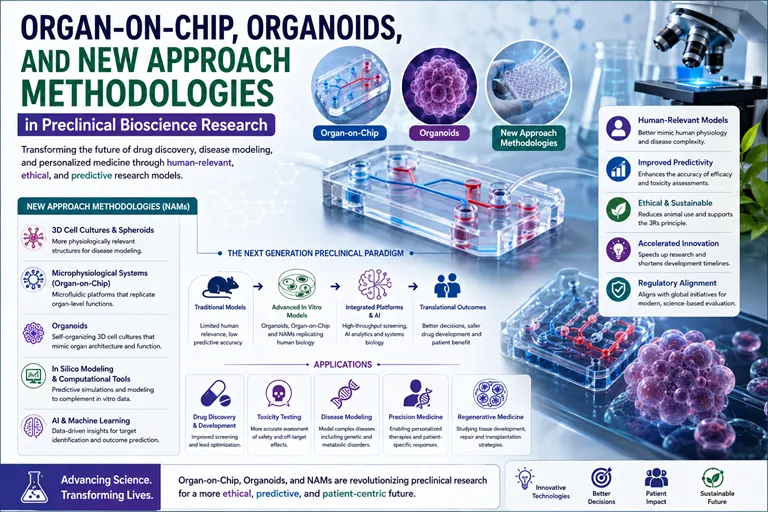
These innovations are redefining drug discovery, disease modelling, toxicology, precision medicine, and translational research, and they represent some of the most exciting developments in modern biosciences.
The Limitations of Traditional Preclinical Models
Preclinical research has traditionally relied on:
- Two-dimensional cell cultures
- Animal models
- Isolated tissue studies
- Conventional in vitro assays
Although these methods remain valuable, researchers increasingly recognize their limitations.
Common challenges include:
- Poor representation of human physiology
- Limited prediction of clinical outcomes
- Species-specific biological differences
- High costs and long study durations
- Ethical concerns regarding animal use
- Difficulties in modelling complex diseases
- Limited ability to study personalized responses
Many promising therapies that demonstrate success in animal models ultimately fail during human clinical trials due to these limitations.
These challenges have accelerated the search for more predictive and human-relevant research models.
What Are New Approach Methodologies?
New Approach Methodologies, commonly referred to as NAMs, encompass innovative scientific methods that improve or replace traditional animal testing and conventional preclinical models.
NAMs include:
- Organ-on-chip technologies
- Organoid systems
- Microphysiological systems
- Advanced cell cultures
- Three-dimensional tissue models
- Computational modelling
- Artificial intelligence approaches
- In silico simulations
- Human-derived cellular systems
- Systems biology approaches
The primary goal of NAMs is to improve the prediction of human biological responses while enhancing scientific efficiency and reducing dependence on animal testing.
The Rise of Human-Relevant Models
Human biology is extraordinarily complex. Disease processes often involve interactions among multiple cell types, tissues, genetic factors, and environmental influences.
Modern bioengineering approaches attempt to recreate this complexity using sophisticated experimental systems that more closely resemble human physiology.
The emergence of human-relevant models has become particularly important in:
- Drug development
- Toxicology testing
- Precision medicine
- Rare disease research
- Cancer biology
- Infectious disease studies
- Regenerative medicine
These approaches are helping researchers bridge the gap between laboratory experiments and clinical applications.
Understanding Organ-on-Chip Technology
Organ-on-chip technology is one of the most important innovations in modern bioengineering.
An organ-on-chip is a microengineered device designed to mimic the structure and function of human organs using living cells, microfluidics, and biomaterials.
These devices attempt to recreate:
- Tissue architecture
- Mechanical forces
- Cellular interactions
- Biochemical environments
- Physiological responses
Unlike conventional cell cultures, organ-on-chip systems can reproduce dynamic biological processes in a highly controlled environment.
How Organ-on-Chip Systems Work
Most organ-on-chip platforms combine:
- Human cells
- Microfluidic channels
- Biomaterials
- Mechanical stimulation
- Controlled chemical environments
These systems simulate physiological conditions that are difficult to reproduce using traditional laboratory methods.
Examples include:
- Lung-on-chip
- Liver-on-chip
- Heart-on-chip
- Kidney-on-chip
- Gut-on-chip
- Brain-on-chip
- Skin-on-chip
Each platform provides unique opportunities for studying human biology and disease.
Applications of Organ-on-Chip Technologies
Organ-on-chip systems are increasingly used in:
- Drug discovery
- Toxicology studies
- Disease modelling
- Personalized medicine
- Pharmacokinetic studies
- Infectious disease research
- Cancer research
- Environmental health studies
The pharmaceutical industry is increasingly interested in these technologies because they may improve the prediction of human responses during drug development.
Understanding Organoids
Organoids are three-dimensional miniature tissue structures grown from stem cells or progenitor cells that self-organize into structures resembling human organs.
Unlike traditional cell cultures, organoids can replicate many features of real tissues, including:
- Cellular diversity
- Tissue organization
- Functional properties
- Developmental processes
Organoids have rapidly become valuable research tools because they can provide highly relevant models of human biology.
Types of Organoids
Researchers have successfully developed:
- Brain organoids
- Liver organoids
- Intestinal organoids
- Lung organoids
- Kidney organoids
- Pancreatic organoids
- Tumour organoids
- Retinal organoids
These systems offer remarkable opportunities for studying both normal and diseased tissues.
Applications of Organoid Research
Organoids are widely used in:
- Developmental biology
- Cancer research
- Personalized medicine
- Genetic disease studies
- Drug screening
- Infectious disease research
- Regenerative medicine
Patient-derived organoids are particularly promising because they may enable individualized therapeutic testing.
Organ-on-Chip Versus Organoids
Although both technologies are highly valuable, they have distinct characteristics.
Organ-on-chip systems excel in:
- Controlled environments
- Mechanical stimulation
- Fluid flow simulation
- Multi-organ interactions
- Engineering precision
Organoids excel in:
- Tissue self-organization
- Cellular complexity
- Developmental biology
- Patient-specific modelling
- Long-term tissue studies
Increasingly, researchers are combining these approaches to create even more sophisticated experimental systems.
Multi-Organ and Body-on-Chip Systems
The next generation of organ-on-chip research involves linking multiple organ systems together.
Examples include:
- Liver-kidney models
- Gut-liver systems
- Heart-lung interactions
- Multi-organ drug metabolism studies
These integrated systems attempt to replicate whole-body physiology and improve the prediction of drug effects.
Artificial Intelligence and NAMs
Artificial intelligence is increasingly being integrated into preclinical bioscience research.
AI can assist in:
- Image analysis
- Drug discovery
- Toxicity prediction
- Disease modelling
- Experimental design
- Data integration
- Personalized medicine
Combining AI with organ-on-chip and organoid technologies has the potential to dramatically accelerate biomedical research.
The Role of NAMs in Drug Development
Drug development remains expensive, time consuming, and associated with high failure rates.
NAMs can potentially improve this process by:
- Enhancing predictive accuracy
- Reducing late-stage failures
- Improving safety assessment
- Supporting precision medicine
- Accelerating therapeutic development
As these technologies continue to mature, they may significantly reshape pharmaceutical research.
NAMs and the Future of Toxicology
Traditional toxicology testing often relies heavily on animal models.
NAMs offer new possibilities by providing:
- Human-relevant data
- Mechanistic insights
- Faster testing approaches
- Improved reproducibility
- Reduced animal use
Regulatory agencies and scientific organizations worldwide are increasingly supporting the development and validation of these technologies.
Ethical Considerations in Modern Preclinical Research
One of the most important drivers of NAM development is the ethical responsibility to reduce, refine, and replace animal use whenever scientifically appropriate.
Human-relevant models may:
- Improve scientific outcomes
- Reduce animal experimentation
- Enhance reproducibility
- Support more ethical research practices
The development of alternative methods therefore has both scientific and ethical significance.
Challenges Facing Organ-on-Chip and Organoid Technologies
Despite their enormous potential, these technologies still face several challenges.
These include:
- Standardization issues
- Manufacturing complexity
- Cost considerations
- Regulatory acceptance
- Reproducibility challenges
- Data interpretation
- Scalability limitations
Addressing these challenges will require continued collaboration among scientists, engineers, industry, and regulatory agencies.
Research Opportunities in Organ-on-Chip and NAMs
The rapid growth of this field has created substantial opportunities for researchers.
Emerging research areas include:
- Microphysiological systems
- Biomaterials engineering
- Stem cell technologies
- Disease modelling
- Computational biology
- Precision medicine
- Drug screening
- Artificial intelligence applications
- Personalized therapeutics
These interdisciplinary areas are expected to remain major drivers of biosciences innovation for many years.
Publishing Opportunities in Preclinical Bioscience Research
The increasing importance of human-relevant experimental models has created significant opportunities for scholarly publication.
High-impact research areas include:
- Organ-on-chip technologies
- Organoid development
- Disease modelling
- Toxicology innovations
- Drug discovery platforms
- Microfluidics
- Translational bioengineering
- Precision medicine applications
- Regulatory science
- Alternative testing methodologies
Researchers working in these areas are contributing to one of the fastest-growing areas of modern biosciences.
The Importance of Interdisciplinary Collaboration
Successful research in this field requires expertise from multiple disciplines:
- Biology
- Engineering
- Medicine
- Materials science
- Data science
- Computational modelling
- Pharmacology
- Toxicology
The future of preclinical bioscience research will depend heavily on interdisciplinary collaboration and technological innovation.
Soft Note for Researchers
The Journal of Development in Bioengineering and Biosciences welcomes high-quality original research, reviews, and interdisciplinary studies related to organ-on-chip technologies, organoids, microphysiological systems, new approach methodologies, translational bioengineering, drug discovery, and emerging areas of preclinical bioscience research.
Frequently Asked Questions
What are New Approach Methodologies?
NAMs are innovative scientific methods that improve or replace traditional preclinical models and animal testing by using advanced human-relevant experimental systems.
What is an organ-on-chip?
An organ-on-chip is a microengineered system that recreates important functions of human organs using living cells and microfluidic technologies.
What are organoids?
Organoids are three-dimensional miniature tissue structures grown from stem cells that resemble real human organs in structure and function.
Why are organoids important?
Organoids provide more realistic models for studying disease mechanisms, drug responses, and personalized medicine.
Can organ-on-chip technologies replace animal testing?
While they may reduce reliance on animal studies in many areas, complete replacement is still an active area of scientific research and regulatory development.
Why are these technologies important for drug development?
They provide more predictive human-relevant models that may improve safety assessment and reduce late-stage drug failures.
Conclusion
Organ-on-chip systems, organoids, and New Approach Methodologies represent a transformative shift in preclinical bioscience research. These technologies are creating more accurate, ethical, and predictive models of human biology and are accelerating innovation across drug discovery, toxicology, precision medicine, and translational research.
As scientific understanding and technological capabilities continue to advance, these human-relevant models are expected to play an increasingly important role in shaping the future of biomedical research and healthcare innovation.
For researchers in bioengineering and biosciences, this rapidly evolving field offers exceptional opportunities for discovery, collaboration, and scholarly publication, making it one of the most exciting frontiers in modern life sciences.