Why Bioengineering and Biosciences Journals Need a Modern Manuscript Submission System
Why Bioengineering and Biosciences Journals Need a Modern Manuscript Submission System
The publishing landscape in bioengineering and biosciences has changed dramatically over the past decade. Scientific research is becoming increasingly interdisciplinary, collaborative, and data-intensive. Journals now receive manuscripts that involve complex experimental methods, large datasets, supplementary materials, ethical approvals, funding declarations, and multi-institutional authorship.
Managing these submissions through email or outdated publishing systems is becoming increasingly difficult.
For modern bioengineering and biosciences journals, a manuscript submission system is no longer a luxury. It has become a fundamental component of professional scholarly publishing.
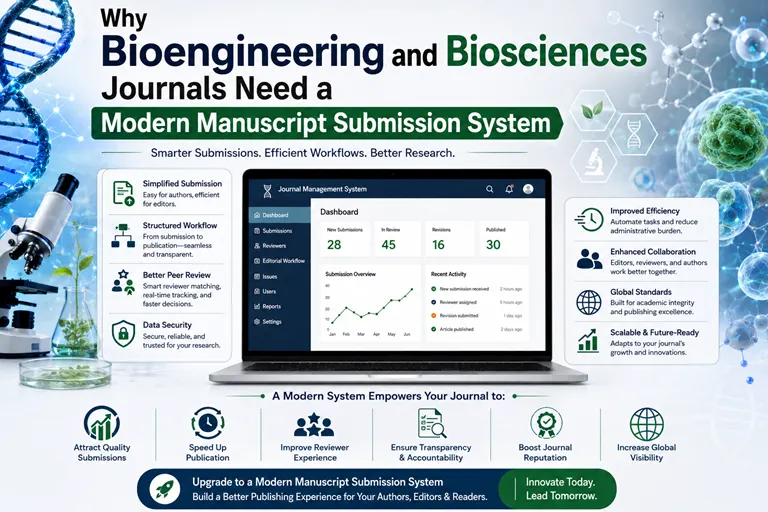
A well-designed submission and editorial management platform improves efficiency, reduces administrative burden, enhances author experience, strengthens peer review, and ultimately contributes to the overall reputation of the journal.
For emerging journals such as the Journal of Development in Bioengineering and Biosciences, investing in a structured manuscript management system can provide a strong foundation for long-term academic growth and publishing credibility.
The Growing Complexity of Biosciences Publishing
Bioengineering and biosciences research often involves:
- Laboratory studies
- Clinical and preclinical experiments
- Biotechnology innovations
- Genomics and molecular biology
- Computational biology
- Organ-on-chip studies
- Multi-author collaborations
- Large supplementary datasets
- Advanced statistical analyses
- Ethical and regulatory documentation
As research becomes more sophisticated, journals need systems capable of managing increasing submission volumes and complex editorial workflows.
Traditional methods such as email-based submissions or manually maintained spreadsheets are no longer sufficient.
The Problems with Outdated Submission Processes
Many journals still rely on old workflows that create challenges for authors, editors, and reviewers.
Common problems include:
- Lost manuscript files
- Duplicate submissions
- Delayed reviewer invitations
- Inconsistent communication
- Difficulty tracking revisions
- Missing author declarations
- Poor metadata management
- Confusing editorial decisions
- Lack of transparency
- Increased administrative workload
These issues negatively affect the reputation of a journal and can discourage high-quality authors from submitting future manuscripts.
Why Authors Expect Modern Submission Systems
Today's researchers are accustomed to digital workflows in nearly every aspect of academic life.
Authors expect journals to provide:
- Online manuscript submission
- Automated acknowledgements
- Submission tracking
- Revision management
- Reviewer feedback access
- Clear communication
- Easy document uploads
- Status notifications
- Mobile-friendly interfaces
When a journal lacks these features, authors may perceive it as unprofessional or technologically outdated.
This perception can directly impact submission rates and journal growth.
The Role of a Modern Manuscript Submission System
A modern submission platform acts as the operational center of a scholarly journal.
It supports every stage of publishing:
- Author registration
- Manuscript submission
- Initial editorial screening
- Reviewer assignment
- Peer review tracking
- Revision management
- Editorial decisions
- Production workflow
- Article publication
- Metadata management
- Archive organization
Rather than managing these processes manually, the system creates a structured and transparent workflow.
Improving Editorial Efficiency
Editors of biosciences journals often manage large volumes of information.
Without an organized system, editorial work becomes time-consuming and error-prone.
A modern manuscript management system can:
- Centralize submissions
- Track manuscript status
- Monitor reviewer progress
- Automate reminders
- Store communication records
- Reduce administrative tasks
- Improve decision-making speed
This allows editors to focus on scientific quality rather than operational challenges.
Enhancing the Peer Review Process
Peer review is the foundation of scholarly publishing.
For bioengineering and biosciences journals, maintaining review quality is particularly important because published findings may influence future scientific research, healthcare applications, biotechnology development, and industrial innovation.
Modern systems improve peer review by providing:
- Reviewer databases
- Automated invitations
- Review reminders
- Confidential review management
- Revision tracking
- Editorial oversight
- Decision documentation
This creates a more transparent and accountable review environment.
Supporting Research Integrity
Research integrity has become a major concern across scientific publishing.
Modern manuscript systems help journals manage:
- Conflict of interest declarations
- Ethical approval documentation
- Funding disclosures
- Data availability statements
- Supplementary materials
- Author contribution statements
- Copyright agreements
These features support compliance with international publishing standards and improve trust in the journal.
Better Metadata Management
Metadata is essential for article discoverability.
A modern submission platform can help capture:
- Article titles
- Abstracts
- Keywords
- Author affiliations
- ORCID information
- References
- Publication dates
- DOI information
High-quality metadata improves:
- Search engine visibility
- Citation tracking
- Indexing readiness
- Long-term discoverability
For biosciences journals, where articles often involve specialized scientific terminology, metadata quality is particularly important.
Why Submission Systems Matter for Emerging Journals
New journals often focus heavily on attracting submissions while underestimating the importance of publishing infrastructure.
However, a professional submission system can significantly improve:
- Journal credibility
- Author confidence
- Editorial efficiency
- Reviewer engagement
- Publication quality
- Future indexing opportunities
For emerging journals, the submission experience often becomes part of the journal's reputation.
A poor experience may discourage future submissions, even if the journal publishes good science.
Supporting Journal Growth
As journals become established, submission volumes generally increase.
A scalable manuscript management platform allows journals to:
- Handle more submissions
- Expand editorial teams
- Add new sections and special issues
- Manage larger reviewer databases
- Improve communication
- Maintain consistent workflows
Without a modern platform, growth can become difficult to manage.
Integration with DOI and Publishing Workflows
A manuscript submission system should support more than peer review.
Modern platforms should also facilitate:
- DOI planning
- Metadata preparation
- Article publishing
- Archive management
- Citation information
- Publication statistics
As journals grow, these features become increasingly important for professional publishing operations.
Why Modern Platforms Improve Journal Credibility
Researchers often evaluate a journal based on:
- Website quality
- Submission process
- Editorial transparency
- Publishing standards
- Peer review professionalism
A modern manuscript submission system demonstrates that the journal is committed to professional scholarly publishing.
This can positively influence author confidence and institutional perception.
The Advantages of Integrated Journal Platforms
Integrated journal platforms combine:
- Journal website
- Submission system
- Editorial workflow
- Reviewer management
- Publishing tools
- Archive management
This approach reduces fragmentation and creates a smoother publishing experience.
ScholarJMS and Modern Journal Management
Modern platforms such as ScholarJMS are designed specifically for scholarly publishing.
ScholarJMS supports:
- Journal website setup
- Manuscript submission
- Editorial workflow
- Reviewer management
- Article publishing
- Volume and issue management
- Responsive design
- Author communication
For new bioengineering and biosciences journals, this type of integrated system can significantly simplify journal operations.
OJSCloud and Journal Publishing Support
Many journals require additional support beyond software.
OJSCloud provides assistance with:
- OJS hosting
- Journal launch consulting
- OJS migration
- Technical support
- ISSN consulting
- Publishing advisory services
This can be particularly valuable for institutions launching new journals or upgrading existing systems.
The Role of DOI Planning
As journals begin publishing regularly, DOI planning becomes essential.
GetDOI supports journals with:
- Crossref DOI guidance
- DOI workflow planning
- Metadata preparation
- DOI sponsorship support
- Publishing consultation
A structured DOI workflow complements a modern manuscript management system and improves long-term journal sustainability.
Need Help Building a Modern Journal Publishing Workflow?
We can help with:
- ScholarJMS journal website setup
- Manuscript submission system implementation
- OJS hosting and support
- ISSN consulting
- Crossref DOI support through GetDOI
- Journal launch consulting
- Editorial workflow setup
- OJS migration support
WhatsApp: +91 82003 85143
Email: inquiry@ojscloud.com
Frequently Asked Questions
Why does a biosciences journal need a manuscript submission system?
A manuscript management system improves editorial efficiency, peer review quality, communication, and publishing transparency.
Can journals manage submissions through email?
Small journals may initially use email, but this approach quickly becomes inefficient as submission volumes increase.
Does a submission system improve journal credibility?
Yes. Professional submission workflows improve author experience and strengthen the journal's reputation.
Is a submission system necessary for new journals?
Yes. Building a structured workflow from the beginning helps journals scale efficiently.
Can manuscript systems support DOI workflows?
Modern platforms can facilitate metadata preparation and DOI implementation.
Is ScholarJMS suitable for biosciences journals?
Yes. ScholarJMS provides journal website management, manuscript submission, editorial workflow, and publishing support designed for scholarly journals.
Conclusion
The future of scholarly publishing in bioengineering and biosciences depends not only on scientific quality but also on publishing infrastructure.
As research becomes increasingly collaborative and data-intensive, journals need systems that can manage complex workflows efficiently and transparently.
A modern manuscript submission system improves editorial management, supports peer review, enhances author experience, strengthens research integrity, and prepares journals for long-term growth.
For emerging journals in bioengineering and biosciences, investing in a professional manuscript management platform is an investment in credibility, efficiency, and future success.
For support with journal website setup, manuscript submission systems, OJS hosting, ISSN consulting, Crossref DOI guidance, and journal launch services, please contact:
WhatsApp: +91 82003 85143
Email: inquiry@ojscloud.com